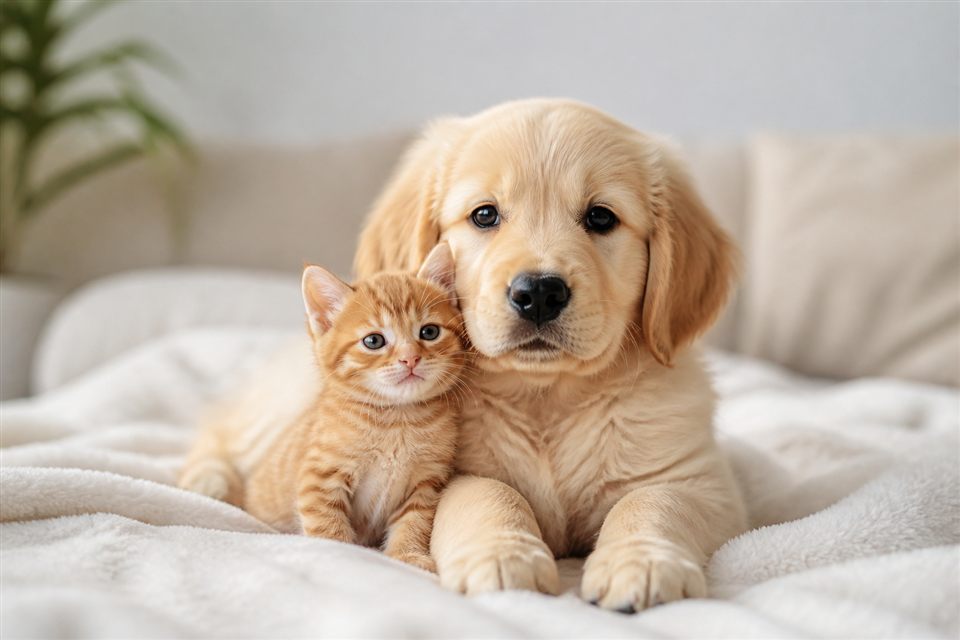
Jordan held Pip, a 4-lb kitten, against a closed bathroom door in Raleigh at 4:15 p.m. Oak, the 45-lb retriever mix, snuffled the gap and hammered the drywall with his tail. The $28 baby gate waited in the hall, still in the carton. Pip had been in the house for 6 hours after a 90-minute car ride. Jordan's cousin had texted: let them work it out. Jordan did not answer. Oak is friendly. A friendly mouth is still a mouth on a 4-lb body. Pip's carrier sat on the sink. A $79 cat tree was scheduled for Thursday. Until then, the shower rod and a folded towel on the tank were the only up-high options. Jordan wanted the first look to last 3 minutes and end bored.
Key points at a glance
- Swap scent for 24–48 hours before a face-to-face: towels, toys, and a blanket from each bed.
- Use a baby gate and keep the 45-lb dog on a leash for every early look.
- Give the 4-lb kitten vertical escape routes the dog cannot follow.
- Never let them work it out. A happy retriever can end a kitten in one shake.
- Keep sessions to 2–5 minutes. Crate the dog if he cannot think, even if his tail is wagging.
Scent, gate, leash—then a boring look
Day 0–2: Pip lives in one room with food, litter, and a hiding box. Rub a towel on Oak, leave it with Pip. Rub a towel on Pip, leave it in Oak's crate. Feed both on opposite sides of a closed door so the gap smells like chicken, not like a raid.
Install the $28 gate. Oak on a 6-foot leash, treats ready, 8–10 feet back. Open the bathroom so Pip can see through the gate from a carrier or a high towel. If Oak lunges, you were too close. Increase distance. Click or mark for a glance at the kitten, then food on the floor. Pip should be able to break off and go up. A 3-minute session that ends with both eating is a win. A 20-minute stare-down is not.
Escape routes and when to crate
A 4-lb kitten needs shelves, a tree, or a room the 45-lb dog cannot enter. Until Thursday's $79 tree arrives, keep Pip's door as a retreat and add a folding gate plus a chair she can climb. Do not hold her out like a toy. Do not let Oak "say hi" nose-to-nose on the floor on day one.
If Oak's tail is a drum, his mouth is open, and he cannot take a treat, he is over-aroused. Park him in his crate with a stuffed toy for 15–30 minutes. Friendly is not the same as safe. Repeat short gated looks 3–4 times a day. Free access comes after days to weeks of boring, not after one cute photo.
Stop and call your vet or a behavior professional if Pip hides without eating for 24 hours, if Oak fixates and will not disengage, or if there is any bite.
| Stage | Time | Rule |
|---|---|---|
| Scent swap only | 24–48 hours | No visual contact yet |
| Gated look, dog leashed | 2–5 minutes, 3–4×/day | 8–10 ft start; treats for calm glances |
| Same room, kitten high | After several calm days | Leash on; kitten can leave up |
| Dog over-aroused | 15–30 min crate break | Wagging does not veto the crate |
| Unsupervised together | Not on day 1, often not week 1 | Never "work it out" |
Jordan set the gate that night, swapped towels, and ran a 3-minute look at 4:15 p.m. the next day. Oak ate cheese at 9 feet. Pip watched from the tank. No one worked it out. Thursday's tree gave Pip a second floor the retriever cannot use.
This article is general education, not a veterinary diagnosis. Contact a veterinarian after any bite, after a kitten who will not eat, or if the dog cannot disengage from the kitten.