Priya's alarm was set for 6:30. Fig, her three-year-old orange tabby, opened the shift at 4:50 with a polite chirp, then a walk across her bladder, then a water glass tapped toward the edge. She fed him on night four because she had a 9 a.m. meeting. By Monday he was starting at 4:35. The kibble bag lived in the hall closet. He knew the hinge.
Key points at a glance
- Cats are crepuscular; dawn activity is biology, not a personal attack.
- Feeding at 5 a.m. teaches an earlier clock, not a grateful cat.
- A timed feeder plus a boring human beats a 20-minute argument in the dark.
- Play and a meal before bedtime close the hunt that otherwise lands on your chest.
- Hunger from a too-small dinner can look like "he just wants snacks."
- A senior cat who suddenly yowls at dawn needs a vet visit.
Why 5 a.m., and why food?
Birds start. Light leaks under the blind. Fig's stomach and hunting clock wake together. Indoor cats still run that program. If the only reliable payoff at dawn is you plus the closet hinge, he will clock in. Priya thought she was being kind. She was paying the behavior. Cats are excellent at shifting a schedule five minutes at a time.
Some cats are actually empty. A 6 p.m. dinner and nothing until morning is a long gap. Others have learned that any sound earns a scoop, including the 2 a.m. stretch-and-meow.
What makes the 5 a.m. shift worse?
Inconsistent nights. If you give in on Sunday and hold the line on Monday, Fig runs the Sunday plan. Laser play at 10 p.m. with no catch and no meal leaves a hunt unfinished. That hunt shows up on your ribs at 5:01. Yelling or spraying water adds adrenaline. He will still want breakfast. He will also be louder.
| Dawn move | What it usually means | What you change |
|---|---|---|
| Chirp, then walk on your bladder | Paid habit, dawn clock | Timed feeder; no talking |
| Glass or phone knocked | You responded to noise before | Remove the props |
| Yowl that sounds raw and new | Pain, thyroid, cognitive change | Vet this week |
| Only happens if dinner was skipped | True hunger | Add a late meal or puzzle feeder |
How do you get past 5 a.m. without hating the cat?
Put breakfast on a timer. A $30 automatic feeder in another room, set for 5:15, then 5:30, then 5:45 over two weeks, moves the party off your pillow. Priya put Fig's feeder in the spare room and closed her bedroom door. The first three mornings he scratched. She did not answer. On morning six he was crunching down the hall when her alarm went off.
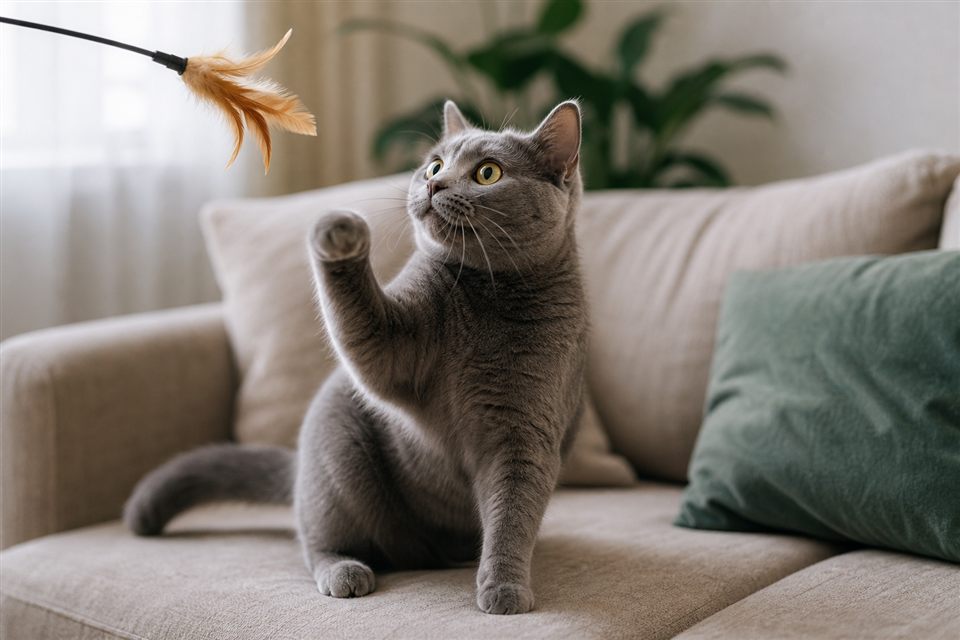
Be dull. No eye contact. No "Fig, stop." No feeding from the bed. If you get up to pee, do not visit the kibble bag. Play at 9:30 p.m. for 10 minutes with a wand until he grab-and-kicks, then feed a real meal. Hunt, catch, eat, groom, sleep is the sequence his body already knows.
If he is thin or truly empty overnight, split calories: a third at 7 a.m., a third at 6 p.m., a third in the timed feeder at 5:30. You are taking yourself out of the 4:50 slot. Cats over 10 who start night wailing need bloodwork. Hyperthyroidism, high blood pressure, and arthritis make dawn vocal. Priya lasted 11 days before she slept through the first chirp. Fig still prefers mornings. He just prefers them in the spare room.
This article is for general education only and does not replace veterinary care. Call your vet if dawn crying is new, if your cat is losing weight, or if he seems painful or disoriented at night.