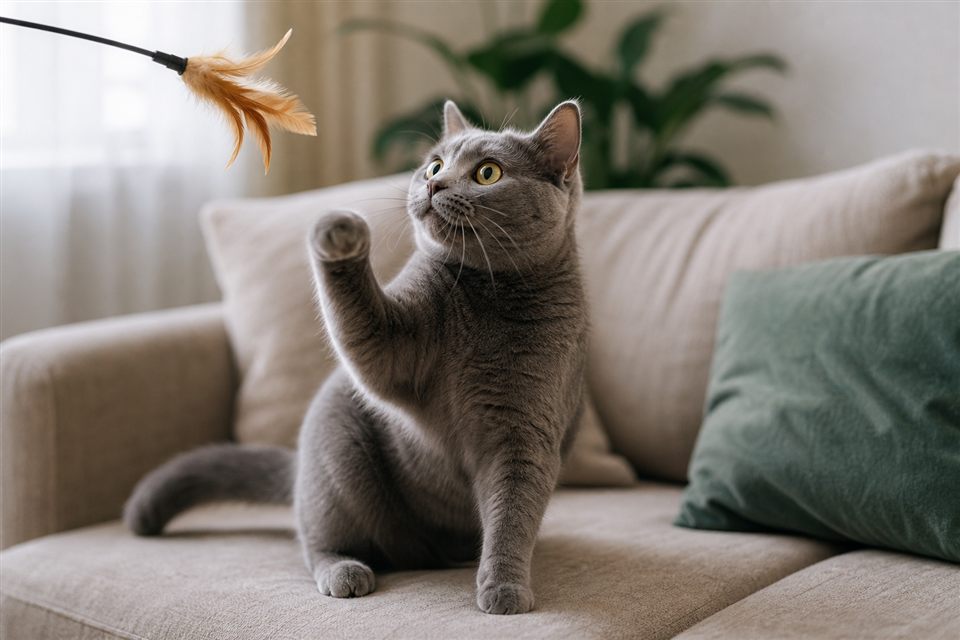
Every evening when Nadine unlocked her apartment door, her gray shorthair, Clover, appeared in the hallway with his tail straight up and the tip quivering like a tuning fork. The whole tail seemed to buzz—not a swish, not a lash, but a rapid fine vibration Nadine had never seen in dog greetings. She wondered if Clover was angry, nervous, or ill. He was none of those. He was performing one of the clearest feline hello signals: excited affection directed at a favorite human.
Key points at a glance
- Tail quivering upright when greeting you is usually positive excitement, often paired with purring and cheek rubs.
- The behavior differs from aggressive tail lashing or irritated twitching at the tail base.
- Intact male cats may also spray with tail quiver—neutering and context distinguish greeting from marking.
- Context, body language, and vocalization clarify meaning better than the tail alone.
- Sudden new tail tremors without greeting context may need veterinary evaluation.
What tail quivering looks like
Clover's greeting sequence:
- Tail rises vertically with a slight hook at the tip (question-mark tail)
- Rapid vibration or quiver runs through the tail, especially the upper portion
- Clover often backs up with raised hindquarters, rubs Nadine's legs, and purrs
- Sometimes a soft chirp or trill accompanies the display
The vibration is visible and sometimes audible when Clover stands on a hard floor. It lasts seconds, not minutes.
Is tail quivering excitement?
In the classic homecoming scenario, yes. Ethologists describe the upright quivering tail as part of a friendly social greeting among cats who share bonds—and cats extend that ritual to trusted humans.
Why cats do it:
Social affiliation. High upright tail means confidence and friendly intent in cat body language. Quivering adds intensity—like an exclamation mark.
Scent marking overlap. Greeting rubs deposit facial pheromones on you. Tail quiver sometimes accompanies marking behavior, reinforcing "you are mine" in the nicest way.
Anticipation. Clover quivered hardest before dinner and after Nadine returned from travel. Expectation amplifies the signal.
Learned ritual. If Nadine petted and talked sweetly every time Clover quivered, the greeting became richer over time.
Nadine was Clover's person. The vibrating tail was joy—not a warning.
How to tell friendly quiver from other tail talk
Cat tails speak in full sentences, not single words. Read the whole body.
Friendly excitement (Clover coming home):
- Tail up, tip may quiver
- Relaxed ears forward
- Purring, rubbing, maybe kneading
- Soft eyes, slow blinks
- Approach toward you
Irritation or overstimulation:
- Tail tip twitching while cat is lying down, ears flattening
- Thumping tail on floor during petting
- Skin twitch along back
- Sudden swat or bite after petting
Fear or conflict:
- Tail puffed, arched back
- Low or tucked tail with tense body
- Hissing, hiding
Predatory focus:
- Tail tip twitch low behind furniture while stalking a toy
- Crouched posture, fixed stare
The speed, height, and pairing matter. Quiver at the top of an upright tail during approach is affection. Sharp lashes at knee height during belly rubs is "stop."
Tail quiver and urine marking—an important distinction
Intact male cats—and occasionally neutered males or females—may spray urine while standing with a quivering tail against a vertical surface. That is not a greeting at the door.
Clues it is spraying:
- Back turned to wall or furniture
- Tail upright and vibrating while hind feet tread
- Small amount of urine on vertical surface, strong odor
- Happens on objects, not on your shoes during hello
Clover quivered at Nadine's ankles without spraying. If spraying appears, consult your vet about neutering status, stress, and environmental changes.
When tail twitching may need a vet
Unusual tail movement outside greetings warrants attention:
- Persistent tremor at rest
- Loss of tail mobility or pain when touched
- Tail held permanently low due to injury
- General neurologic signs—weakness, balance problems
Age-related discomfort can change how a cat greets you. Nadine would call the vet if Clover's quiver became constant, painful, or paired with hiding.
How to respond to your cat's greeting quiver
Acknowledge it. Soft voice, cheek scritches, and calm hello reinforce the bond Clover expresses.
Do not grab the tail. Even friendly cats dislike tail handling.
Offer predictable routine. Cats who greet intensely often thrive on consistent arrival times and play sessions after work.
Film it once if you are unsure—compare to irritation clips online or ask your vet at a wellness visit.
The bottom line
Clover's tail vibrated when he saw Nadine because he was excited, affectionate, and glad she was home—the feline equivalent of a joyful shout. Upright quivering during approach is usually positive, distinct from thumping irritation or fear puffing. Watch the full body, know the difference from spraying, and see your vet if tail movement changes suddenly without a social context. Nadine still smiles every time she turns the key and hears Clover's tiny tail buzz before the purring starts.
This article is for general education only and does not replace advice from a licensed veterinarian.