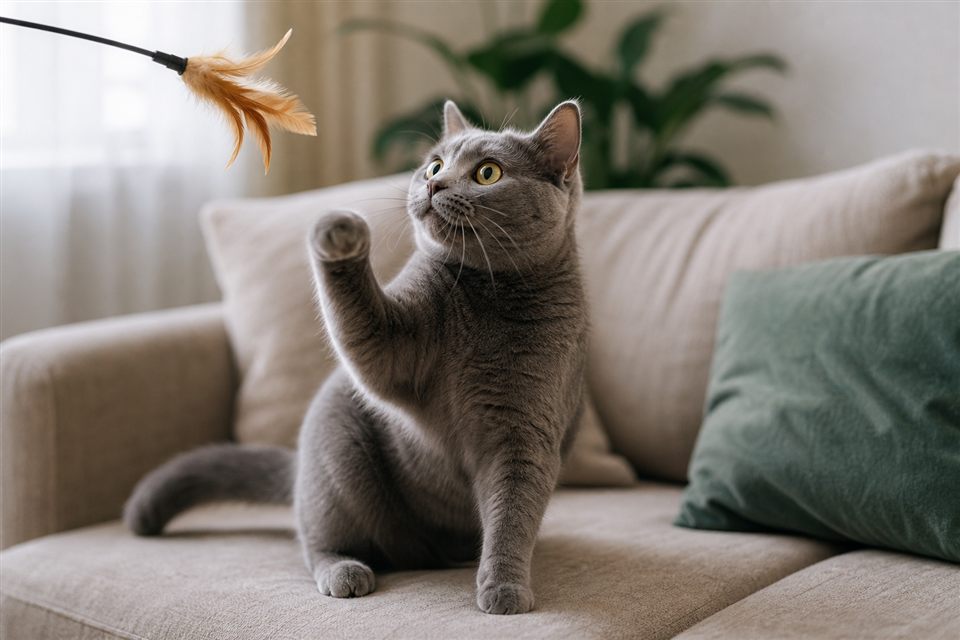
Perched on the bookshelf, Nimbus locked onto a spider near the ceiling light and emitted rapid staccato chirps — jaw trembling, tail twitching, unable to reach his quarry. His owner, Leo, had heard the sound called everything from "bird watching chatter" to "killer mode activated." Both descriptions touch the truth.
Key points at a glance
- Chirping at ceiling bugs is a predatory vocalization — excitement plus frustration at unreachable prey.
- The jaw chatter mimics the killing bite motion used on small animals.
- Indoor cats need outlets for hunting behavior; ignoring it builds restless energy.
- Redirect with wand toys and puzzle feeders — not punishment for instinct.
- Occasional ceiling stalking is healthy; obsessive fixation may need enrichment review.
What the chirp means
Ethologists describe this sound as predatory chatter or frustrated hunting vocalization. Cats produce it when prey is visible but inaccessible — birds through windows, flies on ceilings, lizards behind glass. The jaw shivers as if practicing a neck bite. Nimbus was not singing; he was rehearsing a kill he could not complete.
Some cats chirp when excited generally, but bug-on-ceiling contexts almost always involve prey drive.
Why ceilings are cat torture
Vertical prey exploits a gap in feline floor-hunting defaults. A moth at the crown molding is maddeningly out of leap range. Extended staring and chirping burn focus without closure — unlike floor hunts where a paw swipe might succeed.
Redirecting prey drive productively
You cannot eliminate hunting instinct, but you can satisfy it:
- Scheduled wand play: Ten to fifteen minutes twice daily mimicking bird or bug movement — erratic speed, vertical jumps, final catch on a toy mouse.
- Food puzzles: Dry kibble or treats in puzzle balls replace some stalking calories with foraging effort.
- Bug duty: Safely remove insects when possible so cats are not left in permanent frustrated watch. Avoid toxic sprays with cats present.
- Window perches: Bird feeders outside provide visual hunting for chirpers — with glass preventing actual catches.
After intense ceiling sessions, initiate play so pent energy discharges into legal prey.
What not to do
Laughing and pointing without follow-up play leaves drive unresolved. Laser pointers alone frustrate many cats because there is no tangible catch — always end with a physical toy kill. Punishing chirping makes no sense; the cat is doing exactly what evolution built.
When it becomes excessive
If Nimbus ignored food, lost sleep, or paced ceilings hourly, review overall enrichment and stress. Rare compulsive fixation warrants a vet behavior discussion. Normal bug chirping is episodic and content-adjacent — intense but finite.
The bottom line
A cat who chirps at bugs on the ceiling is voicing predatory excitement at unreachable prey — and you can redirect that drive with interactive hunting play and foraging toys. Leo now keeps a feather wand by the bookshelf; Nimbus still announces spiders, but settles faster after a simulated hunt. Honor the hunter; give him something he can catch.
This article is for general education only and does not replace advice from a licensed veterinarian.