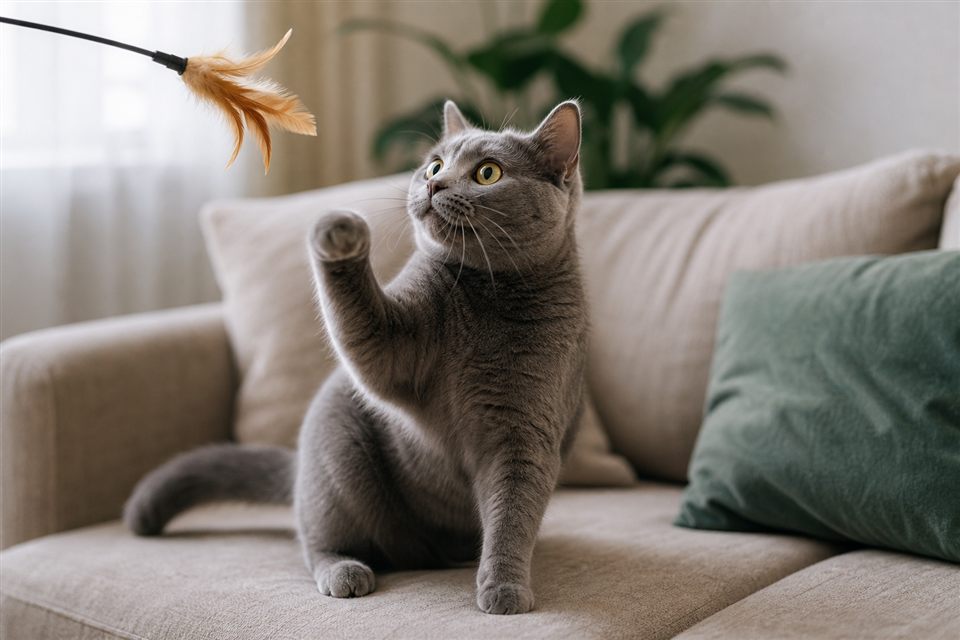
Tess heard it first at 7:10 a.m.: a stuttering "ek-ek-ek" from the living room, then a thud as Pippin, her four-year-old orange cat, hit the glass. A sparrow was on the feeder 6 feet away. The window was locked. The screen was fine. Pippin's jaw trembled like a tiny engine. Tess had thought the sound was a squeaky toy under the couch until she saw the whole performance, tail lashing, every weekday when the sparrows hit the nyjer tube.
Key points at a glance
- Chirping and chattering at birds is a hunting sequence with the prey locked outside.
- Closed glass does not make the cat "confused"; it makes the hunt unfinished.
- A few minutes of window TV is enrichment; hours of frantic slamming is stress.
- Move feeders farther out, add a perch, and follow bird time with a wand toy.
- Do not punish the noise; you cannot scold a cat out of being a predator.
- Sudden howling, drooling, or a cat who stops eating after bird sessions needs a check.
What is that chirp actually for?
Researchers still argue the fine print. The practical version: Pippin is running the mouth part of a kill-bite without a bird in his teeth. The jaw chatter looks like the motion cats use to snap the neck of small prey. The chirp can also be an excited call, closer to "I see it" than to a meow for dinner.
He is not trying to talk to the sparrow in English. Indoor cats with a view get the stalk and the stare and then a wall. For Pippin the leftover energy went into glass, blinds, and that 7 a.m. soundtrack.
Is window watching good or bad?
Good, in doses. Bird TV beats a blank wall. Bad, when the cat drools, screams, loses hair on the sill, or redirects onto another cat the second the sparrow leaves. Pippin once spun and smacked Tess's ankle. That is redirected hunting, the same pattern as hallway ambushes.
A feeder stuck to the glass is a 12-hour slot machine. Tess moved hers to a pole 12 feet from the window after a week of 6 a.m. body slams. Pippin still watched. He stopped ricocheting.
| Window setup | Cat's experience | Tweak |
|---|---|---|
| Feeder on the glass | Prey at nose distance, no catch | Move feeder 10–15 feet out |
| Bare sill, 2 inches wide | Unstable, more slamming | Add a sturdy perch or hammock |
| Closed blinds all day | Zero visual hunt, more night zoomies | Open a slice of view on a schedule |
| Two cats, one window | Fighting over the hunt | Second perch, or a second window |
| Open window, no screen | Real hunt, real fall risk | Screens, locks; no "just an inch" |
How do you keep the chirping from turning into a problem?
Give the hunt an ending. When the sparrows leave, or after 15 minutes of chatter, Tess picked up a wand toy and let Pippin complete the sequence on a feather. Then breakfast. The chirp became a cue for play, not for glass.
Add a perch that does not slide. A $30 window hammock rated for 20 pounds, installed into studs or with honest suction on clean glass, beats a wobbly stool. If he kneads the blinds, replace the cheap vinyl with something he cannot shred, or skip blinds on that pane.
Do not tap the glass to "show him the bird." You become part of the hunt. Do not let him out "just to try" if he is an indoor cat with no recall. Night chatter at a dark window may be insects around a porch light. Turn the light off.
When is chattering a health flag?
Dental pain can change how a cat moves its jaw. If chatter appears with dropping food, bad breath, or pawing at the mouth, book dentistry. A senior cat who suddenly screams at the window at 2 a.m. may have cognitive change or high blood pressure; that is a vet visit.
Enjoy the weird little sound. Just do not let the glass be the only hunt he gets.
This article is for general education only and does not replace veterinary care. Call your vet if jaw chatter comes with drooling, weight loss, or nighttime distress.