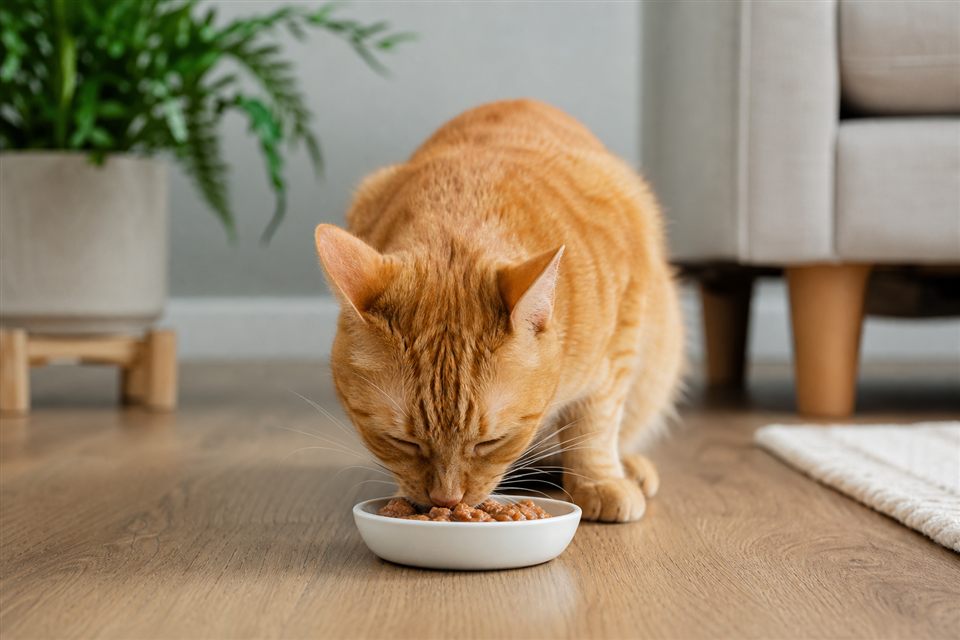
The bowl sits full all day because "cats snack." Meanwhile the vet scale keeps climbing. Meal feeding — measured portions two or three times daily — matches how most indoor cats maintain healthy weight and litter box habits. How much depends on calories in the food, not cup volume alone.
Key points at a glance
- Most healthy adult cats thrive on 2 meals daily; some prefer 3 smaller meals.
- Free-feeding dry kibble drives obesity in many indoor cats — measure instead.
- Average indoor adult needs roughly 200–250 kcal daily — varies by weight and food density.
- Wet food is lower calorie per gram than dry — portion by label calories, not weight look.
- Kittens, seniors, and medical diets follow different schedules — vet guides those.
How many meals per day?
| Schedule | Works well for |
|---|---|
| 2 meals (morning/evening) | Most adult indoor cats |
| 3 smaller meals | Cats who vomit if too hungry, diabetic cats on vet protocol |
| Free-choice dry | Rarely — active outdoor cats or underweight on vet plan only |
Meal feeding lets you notice appetite changes early — empty bowl refusal is a red flag.
Calculating how much food
Step 1: Find calories per cup or can on food label (kcal/kg or kcal/can).
Step 2: Estimate daily calorie need:
- Indoor neutered adult: about 20 kcal per pound body weight daily (rough start).
- 10 lb cat: ~200 kcal/day.
- 15 lb cat: ~300 kcal/day — if overweight, vet may prescribe less for loss.
Step 3: Divide daily calories across meals.
Example: 10 lb cat, 200 kcal/day, food is 100 kcal/can wet → 2 cans total split AM/PM.
Adjust every 2–4 weeks using body condition score — ribs palpable, visible waist.
Wet vs dry portion reality
Dry food — calorie dense; half cup may equal one can wet calorically.
Mixing wet and dry? Count total calories, not scoops plus cans separately.
Weight management formulas lower calories — still measure; do not eyeball.
Why free-feeding fails indoors
- Boredom eating — bowl always available.
- Multi-cat homes — one cat eats all; others obese or starved.
- Cannot tell who stopped eating when sick.
If you free-feed, pre-measure daily allowance in bowl — when gone, gone until tomorrow.
Treats and table food math
Treats 10% max of daily calories — includes dental treats and tuna flakes.
One inch cheddar can be 50 kcal — significant for 10 lb cat.
Special life stages
Kittens under 6 months: 3–4 meals; growth formula; higher kcal per pound.
Senior cats: may need more frequent smaller meals if nausea; kidney diets lower phosphorus — vet sets calories.
Diabetic cats: strict meal timing with insulin — never change schedule without vet.
Signs you are feeding wrong amount
Too much: no waist, hard to feel ribs, lethargy, diabetes risk.
Too little: rib cage prominent, dull coat, begging constantly on measured vet-approved amount — recheck calculation or health.
Transitioning from grazing to meals
Move over one week:
- Remove bowl mid-morning after breakfast eaten.
- Offer only at set times; cat learns schedule within days usually.
- Puzzle feeders for dry portion if cat pace-eats then vomits.
The bottom line
Feed most adult cats two measured meals daily totaling roughly 20 kcal per pound adjusted for body condition and food label density — wet and dry counted in calories, not volume guesses. Free-feeding dry often overfeeds indoor cats. Kittens, diabetics, and weight-loss plans need veterinary tailoring; the schedule matters as much as the scoop size.
This article is for general education only and does not replace advice from a licensed veterinarian. Sudden appetite loss warrants same-day evaluation.