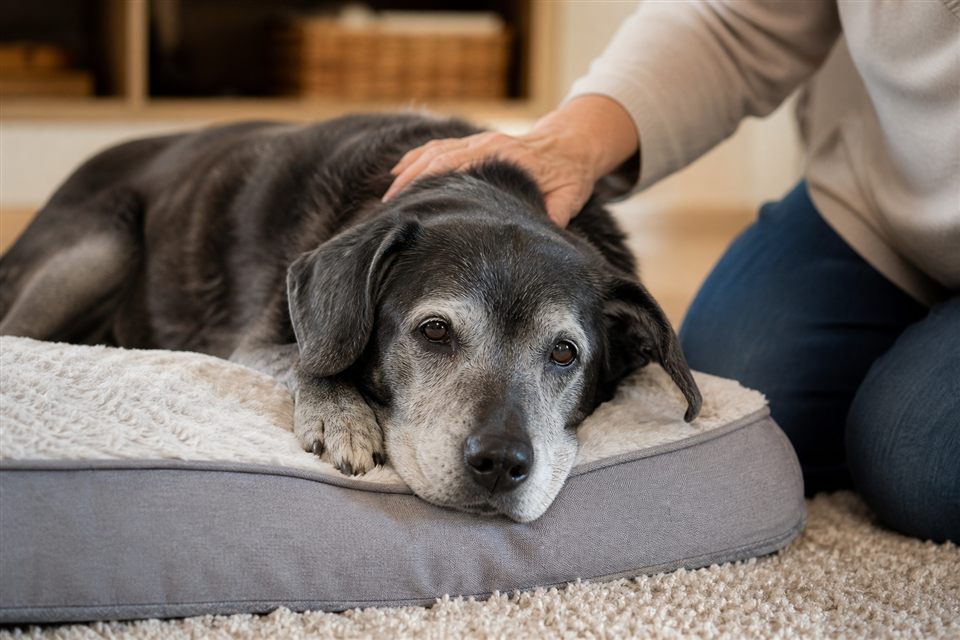
Every October, Helen noticed the same shift in her eleven-year-old mixed breed, Sadie: slower rises from the dog bed, hesitation at the back door, and a quiet whimper on the first truly cold morning. Sadie's arthritis was manageable in summer — short walks, steady medication, a orthopedic bed. Winter stripped away those margins. Barometric pressure drops, cold-stiffened muscles, and icy walks turned Sadie into a dog Helen barely recognized until noon warmth arrived. Helen could not move to Arizona, but she could build a cold-weather arthritis plan that kept Sadie mobile, warm, and out of crisis until spring.
Key points at a glance
- Cold weather does not cause arthritis but worsens stiffness, pain perception, and slip risk on icy surfaces.
- Consistent veterinary pain management matters year-round; winter often requires dose timing adjustments — never change meds without vet guidance.
- Warmth — bedding, coats, heated mats with safety controls — reduces morning stiffness.
- Shorter, more frequent leashed walks on cleared paths beat long icy outings that risk falls.
- Weight control and low-impact exercise preserve muscle that stabilizes arthritic joints.
- Sudden severe lameness, refusal to stand, or appetite loss need urgent evaluation — not assumed "just winter."
Why cold weather hits senior arthritic dogs harder
Arthritis — degenerative joint disease — involves cartilage loss, bone remodeling, and inflammation in one or more joints. Cold ambient temperature reduces blood flow to extremities and makes muscles and connective tissue less pliable. Many owners report increased limping during cold fronts and low-pressure systems; the mechanism blends tissue stiffness with heightened nerve sensitivity rather than new structural damage overnight.
Sadie slept in a drafty hallway until Helen moved her bed away from the exterior door. Morning pain peaked because joints rested in one position for hours without circulation. Slippery floors compounded hip and stifle instability — Sadie braced differently on tile, overloading sore elbows.
Understanding winter as a stress multiplier, not a separate disease, helped Helen prioritize interventions that worked in all seasons but mattered most when temperatures fell.
Veterinary pain management in winter
Sadie took a daily nonsteroidal anti-inflammatory prescribed by her vet with baseline bloodwork monitoring. Helen never added human ibuprofen or aspirin — canine toxicity and GI ulceration risk are real. Winter mornings sometimes needed timing optimization: giving Sadie's medication forty-five minutes before the first outside trip let peak blood levels coincide with the stiffest part of the day, per her veterinarian's adjustment.
Adjunct options Helen discussed included:
Gabapentin or amantadine for neuropathic or wind-up pain during severe cold snaps.
Joint injections (polysulfated glycosaminoglycan, hyaluronic acid, or steroid in select joints) for flare management.
Physical rehabilitation — underwater treadmill, therapeutic laser, acupuncture — when available locally.
Supplements like glucosamine and omega-3 fatty acids supported cartilage health marginally; they replaced nothing in Sadie's prescription plan. Helen treated supplements as slow adjuncts with evidence varying by product quality.
Warmth strategies that actually help
Orthopedic memory foam bed with low sides let Sadie rise without jumping. Helen added a machine-washable cover for urine accidents common in some senior dogs on increased diuretics.
Elevated bed away from drafts — interior wall placement, away from HVAC vents blowing cold air.
Dog coats and sweaters for outdoor trips; dry thoroughly after wet snow walks. Wet fur negates insulation.
Heated pet beds or mats with chew-resistant cords and thermostats — never human heating pads unattended; burns occur on thin senior skin.
Indoor ambient temperature bumped two degrees in Sadie's zone — cheaper than emergency vet visits from a fall.
Helen warmed Sadie's muscles with gentle massage before walks — long strokes on thighs and shoulders, never forcing joints into painful flexion.
Exercise and mobility modifications for icy months
Stopping exercise worsens arthritis through muscle loss. Helen adapted:
Two or three ten-minute walks on salted or cleared paths instead of one thirty-minute trek on ice.
Booties or toe grips for traction — introduced indoors with treats so Sadie wore them without comedy falls.
Leash control prevented Sadie from lunging on slick surfaces.
Indoor enrichment — scatter feeding, nose work, gentle trick training — maintained mental fatigue without joint load.
Swimming or hydrotherapy when local facilities offered winter access — Sadie's best season for building hind-end strength without impact.
Helen cancelled walks on pure ice days and used potty pads near the door as backup — dignity mattered less than a fractured limb from a hip that could not recover like a puppy's.
Home environment changes beyond the bed
Runner rugs on traffic paths from bed to water bowl to door — yoga mats work in a pinch.
Ramp or steps to sofa if Sadie still joined Helen — jumping down cold-stiffened shoulders caused next-day lameness.
Raised food and water bowls if neck or elbow arthritis made head-down eating painful — discuss with vet; not every arthritic dog benefits from elevation.
Night lights for declining vision that misjudges step edges in dark winter mornings.
Weight check monthly — Sadie gained easily with shorter walks; extra pounds loaded every sore joint exponentially.
Nutrition and hydration in cold weather
Joint supplements aside, lean body condition remained Helen's highest-yield nutrition goal. Calorie adjustment matched reduced winter activity.
Omega-3 from veterinary fish oil doses (not random human capsules) supported anti-inflammatory pathways per Sadie's vet.
Adequate water intake — warmed broth over kibble occasionally — kept hydration up when heated houses dried air and Sadie drank less from a cold bowl on the floor.
When winter stiffness is an emergency
Helen called the vet same-day when Sadie could not rise at all, cried when touched, refused food for twenty-four hours, or showed new severe single-leg lameness — possible cruciate tear on ice masquerading as "arthritis flare." Fever, swollen joints, and lethargy suggested infection, not weather.
Annual senior bloodwork before winter caught kidney changes that altered which pain medications were safe — critical before Helen assumed last year's plan still applied.
The bottom line
Sadie still groans on the first frost, but she rises, walks, and sleeps without the crisis winters Helen once dreaded. Senior dog arthritis in cold weather responds to layered care: consistent vet-directed pain control timed for stiff mornings, warmth without burns, traction without ice heroics, muscle-preserving exercise, and a home that does not ask arthritic joints to navigate slip and draft alone. Winter does not have to mean hibernation in pain — Helen proved Sadie could reach spring with dignity by treating cold as a season to plan for, not endure.
This article is for general education only and does not replace advice from a licensed veterinarian.