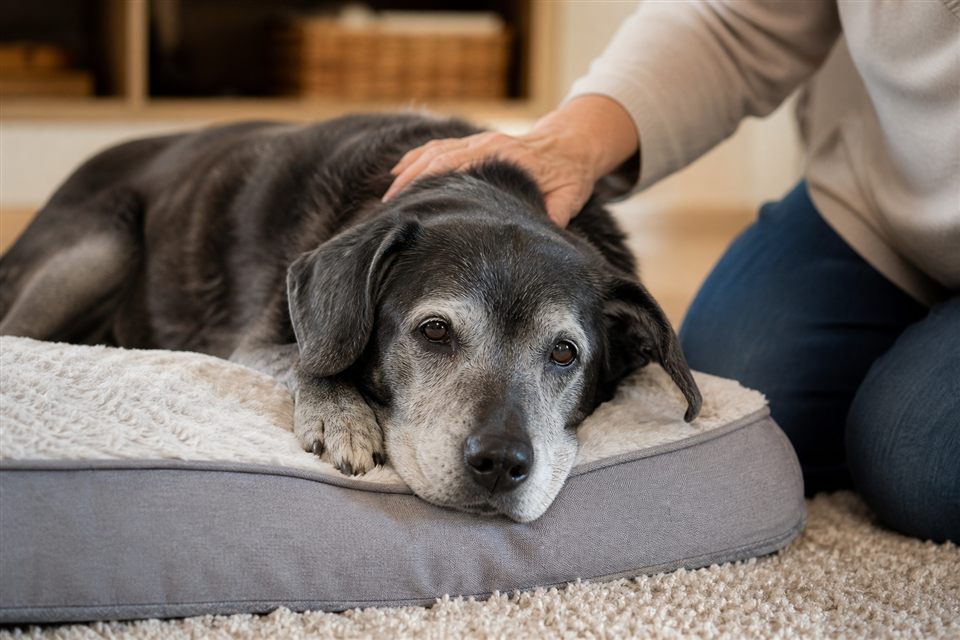
Elaine’s thirteen-year-old poodle mix Otis still wagged when she picked up the leash, then stood in the hallway as if the living room had moved. Midday was the strange part. He would stare at a corner, pace the same half-circle, or forget he had just been outside. Elaine worked from home and needed a daytime plan that did not involve hovering for eight hours.
Key points at a glance
- Keep feeding, walks, and rest in the same order every day.
- Use short, easy “jobs” instead of long training sessions.
- Night lighting and a last potty trip shape how the morning starts.
- Daytime pacing can be anxiety, pain, or hearing loss, not only dementia.
- Medication and diet changes belong to the vet, not a forum thread.
What daytime decline can look like
Canine cognitive dysfunction is the clinic name. At home it looks like Otis getting stuck on the wrong side of a door, greeting Elaine as if she were a guest, or asking to go out and then looking surprised on the grass. Some dogs sleep hard all morning and then roam at 2 p.m.
Do not diagnose from a list on your phone. Thyroid disease, vision loss, arthritis, and urinary infections can copy the same aimless walk. Elaine booked a senior exam first. The vet ruled out a few things and then talked about environment, which is the part you can run during a workday. Treat the house like a map Otis already knows. Rearranging furniture “to keep his mind active” is a mean trick. Novelty belongs in food puzzles, not in the path to the water bowl.
A daytime schedule that reduces the blank stares
| Time block | What to do | Why it helps |
|---|---|---|
| Morning | Same potty route, then breakfast | Starts the day on a known script |
| Mid-morning | Ten-minute sniff walk or yard time | Burns worry without exhausting joints |
| Midday | Quiet rest in a familiar bed | Prevents the afternoon crash-and-pace |
| Afternoon | A simple food job or two cues | Gives the brain a short win |
| Evening | Lights on before dusk, last outing | Cuts the sundown spiral |
Write the order on a sticky note if more than one person is home. Mixed signals are hard on a dog who is already guessing. If Elaine had a meeting, her neighbor used the same door and the same phrase, “back soon.” The tone and the exit still matched.
Keep water where it has always been. When he stands in a corner, walk to him and turn him with a cheerful tap on the hip, then lead him to the bed. Do not scold. He is not testing you.
Enrichment that does not overwhelm
Forget a 30-piece puzzle. Scatter a handful of kibble in a muffin tin or roll a treat in a towel Otis can unroll with his nose. One success is enough. If he leaves food, the puzzle is too hard or his nose is off that day. Offer the meal in the bowl and try again tomorrow.
Short cue games work if the cues are old. “Touch” on your palm, then a treat. “Find it” with a treat in plain sight. New tricks in a new room can spike frustration. Elaine used the hallway because the walls guided him. Rotate two known toys, not a pile. A new squeaker may startle a dog whose hearing comes and goes.
Daytime radio on low can cover street noise that now sounds like a threat. Keep the volume boring.
Pain, sleep, and the vet conversation
Otis paced more on days his hips were stiff. Pain makes any brain look worse. A joint plan, a ramp, and a bed he can step onto without a hop often cut the circling. If he sleeps all day and then is up at night, ask about sleep and about drugs used for canine cognitive dysfunction. Some dogs do better with a prescription. Do not stack supplements from three websites.
Track a few notes: accidents, stuck-in-corner moments, and how long the afternoon rest lasted. That log is more useful than “he seems off.” Elaine still has hard days. The muffin tin comes out at 3:10, not “whenever.” That small dullness is the kindness.
Cognitive changes in an older dog need a veterinary workup. This article cannot diagnose dementia or replace pain control, lab work, or prescription care.