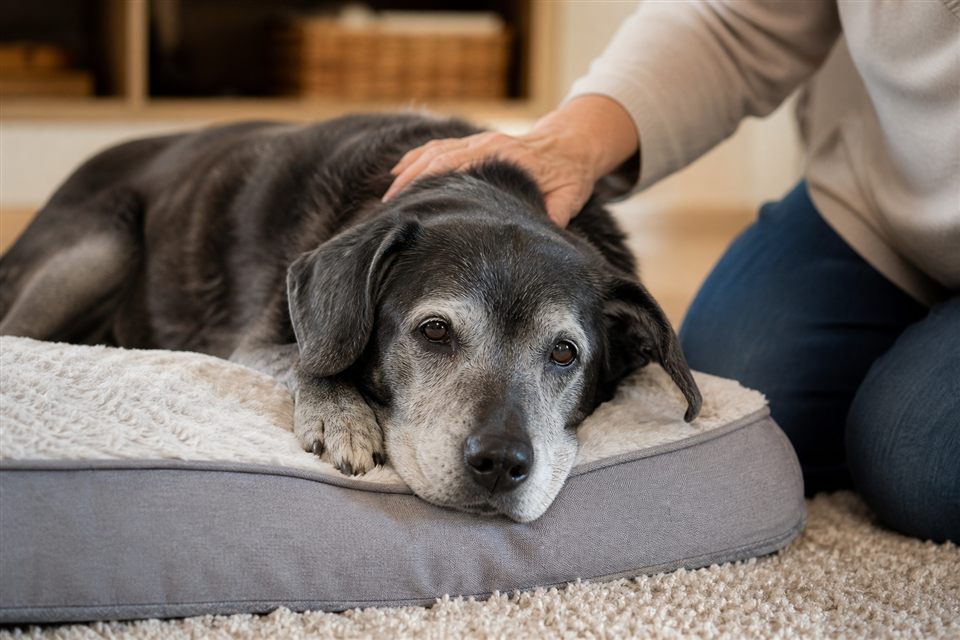
Helen's twelve-year-old Labrador, Buster, started missing treat catches and hesitating at the back porch step she'd descended confidently for a decade. In sunlight, both eyes showed bluish-gray haze—not the sudden white flash of acute injury, but the gradual cloudiness common in senior dogs. Helen's veterinarian diagnosed age-related lenticular changes and early cataract formation in one eye, distinguishing them from painful glaucoma or uveitis requiring emergency treatment. Buster was not fully blind, but vision loss progressed enough that Helen rearranged furniture, added scent cues, and learned verbal navigation commands. Helping a senior dog with cloudy eyes and vision loss at home means adapting the environment, maintaining routine, monitoring for pain, and partnering with veterinary ophthalmology—not assuming cloudiness is harmless without diagnosis.
Key points at a glance
- Cloudy eyes in senior dogs have multiple causes—nuclear sclerosis, cataracts, glaucoma, dry eye, and uveitis—only veterinary exam determines which and whether treatment exists.
- Nuclear sclerosis (gray-blue haze) commonly affects both eyes with minimal vision impact; cataracts block vision progressively and may be surgically removable.
- Home adaptations: consistent furniture layout, textured path markers, night lights, verbal cues, and padded stair edges reduce injury and anxiety.
- Never move food, water, and bed without gradual guided reintroduction—predictability is Buster's map.
- Sudden vision loss, squinting, redness, or bulging eye requires emergency veterinary care regardless of age.
- Blind or low-vision dogs often adapt well mentally when owners avoid pity and maintain confidence-building routines.
What caused Buster's cloudy eyes
Nuclear sclerosis. Normal aging lens hardening creates bluish haze bilaterally. Buster retained functional vision—Helen noticed difficulty mainly in dim light and depth perception at stairs.
Incipient cataract. Right eye showed whitish opacity blocking light partially. Surgical consultation optional while Buster still navigated well; Helen scheduled ophthalmology baseline for progression tracking.
Ruled out by vet: Glaucoma (normal intraocular pressure), uveitis (no pain signs), retinal detachment (no sudden complete blindness).
Helen learned not all cloudiness equals blindness, but all cloudiness deserves professional eyes-on evaluation—literally.
| Condition | Appearance | Vision impact | Treatment |
|---|---|---|---|
| Nuclear sclerosis | Bilateral blue-gray | Mild | None needed |
| Cataracts | White/opaque | Moderate to severe | Surgery possible |
| Glaucoma | Red, teary, enlarged | Painful, rapid loss | Emergency |
| Dry eye | Dull, discharge | Variable | Medication |
Home environment changes Helen implemented
Furniture freeze. Helen stopped rearranging living room. Buster mapped couch, coffee table, and dog bed by memory. When Helen moved one chair, she walked Buster on leash through new path five times with treat rewards.
Scent and texture highways. Helen placed vanilla-scented mat at kitchen entry and rough doormat before porch step—Buster learned texture and smell precede transitions. Essential oils used sparingly and never directly on dog.
Night lights. Plug-in amber night lights in hallways and near water bowl reduced night disorientation when nuclear sclerosis dimmed contrast sensitivity.
Stair and threshold safety. Non-slip strips on porch steps. Baby gate at basement stairs—Buster's depth perception failed there first. Ramps considered for future SUV loading.
Bowl and bed consistency. Water and food bowls stayed in same corner with tactile rug underneath—Buster found them by smell and rug edge underfoot.
Padding hazards. Pool noodle foam on sharp table corners at Buster's head height during low-vision wandering.
Communication and confidence for Buster
Verbal cues. Helen added "step up," "step down," "wait," and "clear" before obstacles. Spoken before physical guidance—Buster learned words predict terrain.
Avoid startling. Helen spoke before entering rooms: "Buster, it's Helen." Hand claps gently before touching sleeping Buster—startle reflex increased with vision loss.
Leash on unfamiliar ground. Yard paths mowed consistently; new parks skipped in favor of familiar sniff routes where Buster's nose led confidently.
Maintain enrichment. Scent work games—hidden treats in boxes—engaged Buster's strongest sense. Vision loss is not cognitive loss; Helen avoided treating Buster like invalid.
No pity voice. Anxious owner energy transferred. Helen used cheerful normal tone during navigation errors when Buster bumped ottoman gently.
Medical and monitoring support
Regular ophthalmology rechecks. Every six to twelve months tracking cataract progression and pressure.
Pain watch. Squinting, rubbing eyes with paws, reluctance to open eyes in light, or head pressing against furniture signaled pain—not normal aging. Helen's vet prescribed artificial tears for mild dry eye contributing to haze discomfort.
Systemic health. Diabetes accelerates cataracts; Helen maintained Buster's weight and annual bloodwork.
Supplements. No proven cataract reversal supplements; Helen declined internet "eye cure" drops after vet confirmed unregulated risk.
Surgery timing. Cataract surgery candidacy depends on retinal health, anesthesia risk at twelve years, and quality-of-life calculus—Helen deferred until Buster's functional vision dropped below safe navigation threshold.
When Helen called the vet urgently
One morning Buster's left eye turned cloudy white overnight with excessive tearing—different from gradual change. Emergency visit ruled out acute uveitis requiring anti-inflammatory treatment. Helen learned rate of change matters as much as cloudiness presence.
Other emergency signs: bulging eye, green/yellow discharge, obvious pain vocalization, collision frequency sudden spike suggesting acute vision drop from retinal issue.
Multi-pet and household considerations
Helen's younger terrier raced past Buster—collision risk. Feeding separated, younger dog's zoomies redirected outdoors, bells on terrier's collar gave Buster auditory warning.
Visitors instructed not to grab Buster from behind. Children taught "say hello first."
Emotional support for owner and dog
Grief for Buster's youthful fetch days was valid. Helen joined senior dog support forums and focused on what Buster still enjoyed—slow walks, cheese, nap beside desk. Buster's tail wagged through adaptation; depression in blind dogs often reflects owner anxiety more than dog distress when environment supports independence.
The bottom line
Helen helped senior dog Buster live well with cloudy eyes and partial vision loss by veterinary diagnosis first, then consistent home layout, scent and texture cues, verbal navigation, night lighting, and pain monitoring. Cloudiness without exam assumes too much; adaptation without pity preserves dignity. Buster bumped one ottoman, learned its new location by afternoon, and slept soundly that night—senior dogs adapt when humans make the world predictable.
This article is for general education only and does not replace advice from a licensed veterinarian.